Ancient Sicyon & Vasiliko: Exploring Greece’s Great Art Hub
Article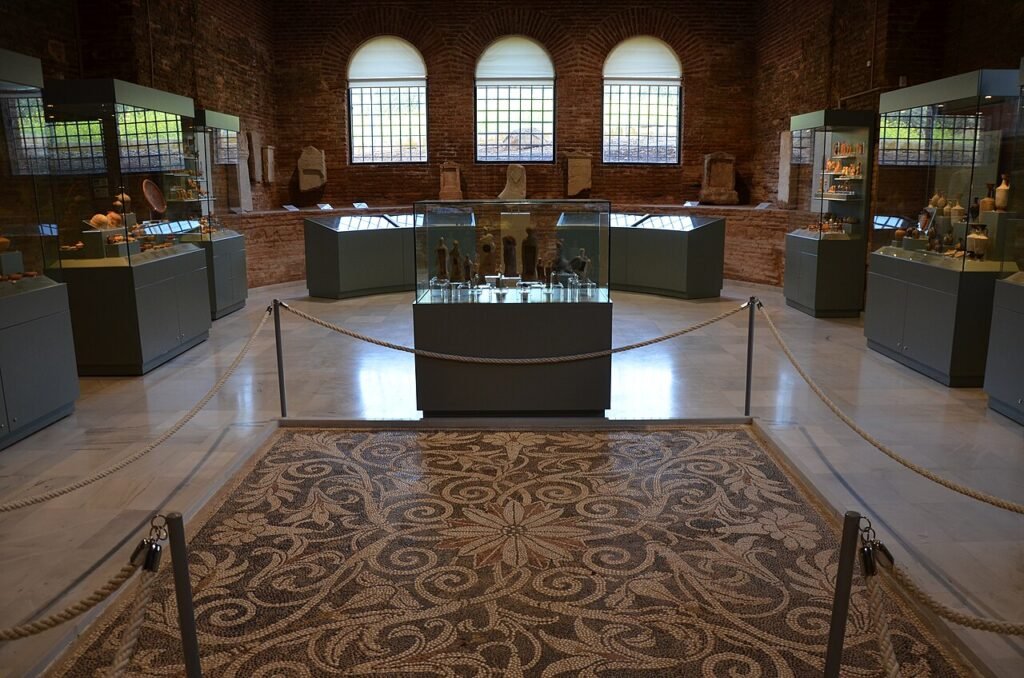
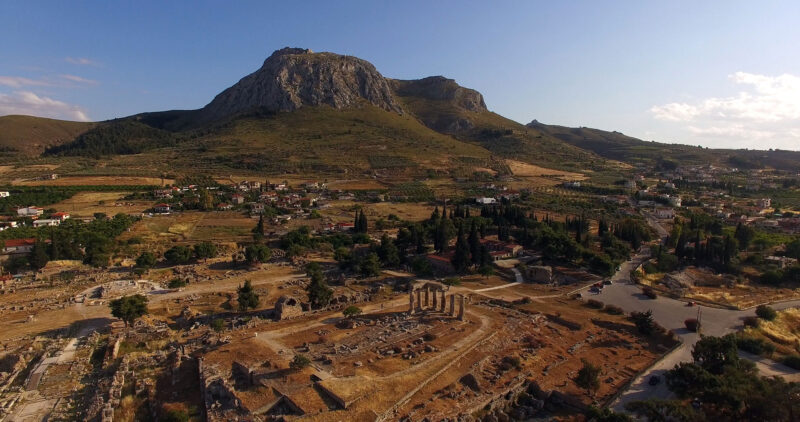
Perched on a privileged plateau overlooking the fertile plains of Kiato and the deep blue waters of the Corinthian Gulf, Ancient Sicyon stands as one of the most significant yet atmospheric archaeological sites in the Peloponnese. Located next to the modern village of Vasiliko, this ancient city-state was far more than a mere military power; it was a pioneering centre for the arts and letters, home to one of the largest and best-preserved ancient theatres in Greece.
Unlike the crowded sites of Mycenae or Epidaurus, Ancient Sicyon remains a “hidden gem.” Here, the silence is broken only by the wind blowing through the olive groves, allowing visitors a rare, personal connection with antiquity. Whether you are a history buff or simply a traveller seeking breathtaking views, Sicyon offers a profound glimpse into a civilization that shaped the aesthetic foundations of the Western world.
Sicyon as a Mediterranean Centre of Art
To understand the importance of Sicyon, one must look beyond the stone ruins and into the history of Greek art. In antiquity, Sicyon was renowned as a “laboratory of culture.” It was the birthplace of the Sicyonian School of painting, which was considered the most prestigious in the Greek world. It was here that Eupompus founded the celebrated Sicyonian school of painting, which attracted great masters such as Pamphilus and Apelles.
The city was equally famous for its bronze-working and sculpture. Lysippos, the personal sculptor of Alexander the Great and the man who defined the “canon” of human proportions in art, was a native of Sicyon. The city’s influence was so great that for centuries, no artist could be considered truly educated without having studied the Sicyonian style. When Demetrius Poliorcetes moved the city from the plain to the naturally fortified plateau in 303 BC, he created a capital that reflected this prestige—a city of marble, bronze, and high intellect.
The Ancient Theatre: An Architectural Masterpiece
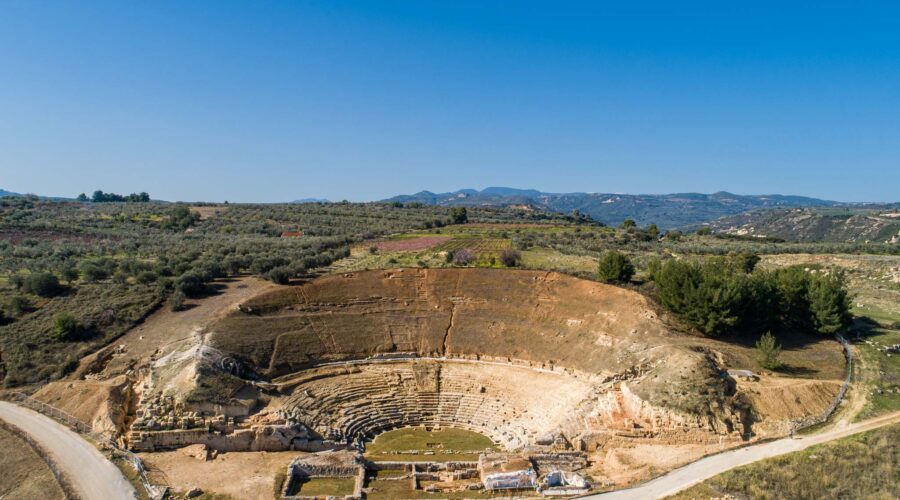
The crown jewel of the archaeological site is undoubtedly the Ancient Theatre. Constructed in the late 4th century BC, it immediately strikes the visitor with its sheer scale. It is considered one of the largest theatres of ancient Greece.
The theatre’s “koilon” (the seating area) is partially carved into the natural slope of the hillside. This technique was a hallmark of Greek engineering, seamlessly blending man-made structures with the landscape. As you stand in the centre of the orchestra, you can still observe the intricate drainage system and the remains of the stage building.
Key Features of the Theatre
- The Orchestra: Remarkably intact, the circular orchestra allows you to test the acoustics, which remain impressive to this day.
- The Vaulted Passages: One of the most unique architectural elements of the Sicyon theatre is the existence of two vaulted tunnels (parodoi) that lead into the seating area. These are rare examples of Greek vaulted architecture, showcasing the advanced skills of Sicyonian builders.
- The View: The theatre was strategically oriented so that the audience could look past the actors and see the Corinthian Gulf. This visual connection between drama and the natural world was a deliberate choice for spiritual and civic events.
The Sicyon Museum: History Within Roman Baths
A short walk from the theatre leads to the Archaeological Museum of Sicyon. The building itself is an artifact; it is housed within a remarkably well-preserved section of Roman Baths. Walking through the museum feels like stepping back into a transition period between the Greek and Roman eras. The brickwork arches and the massive walls of the baths provide an evocative backdrop for the treasures found during excavations.
Inside, the collection highlights the city’s artistic heritage. You will find exquisite mosaic floors featuring intricate geometric and floral patterns, which once adorned the wealthy villas of the city. The museum also houses significant sculptures, including marble statues and architectural members from the city’s public buildings. The pottery collection is particularly noteworthy, as Sicyon was a major exporter of ceramics across the Mediterranean. Detailed information about the museum can be found here: https://visitcorinthia.com/axiotheata/arxaiologiko-mouseio-sikyonas/
The Gymnasium, the Stadium, and the Agora
Beyond the theatre and museum, the site extends into the urban heart of the ancient city. The Gymnasium of Sicyon is one of the most complete examples of its kind. Built on two levels, it features impressive colonnades, classrooms where philosophers once taught, and stone water basins where athletes would wash after their exercises. It is a space that evokes the daily life of ancient youth, where physical training and intellectual pursuit were inseparable.
Nearby lies the Ancient Stadium. Utilizing the natural contours of the plateau, the stadium is partially dug into the earth and partially supported by artificial embankments. It is an incredibly peaceful spot, usually devoid of crowds, where you can walk the length of the track and imagine the cheers of the Sicyonian games. More details on the stadium: https://visitcorinthia.com/axiotheata/arxaio-stadio-sikyonas/
The Agora (marketplace) served as the political and commercial hub. Here, you can trace the foundations of the Temple of Artemis and the Bouleuterion (council house), the latter being a crucial site for the Achaean League, in which Sicyon played a leading role under the statesman Aratus.
Practical Information for Your Visit
Ancient Sicyon is located about 25 kilometres from Corinth, a pleasant 30-minute drive. The route takes you through the coastal town of Kiato before ascending the hills toward Vasiliko village. The drive offers beautiful vistas of vineyards and citrus groves that characterize this part of Corinthia.
How to Get There
From Athens or Corinth, take the National Road (A8) toward Patras and exit at Kiato. Follow the signs for “Ancient Sicyon” or “Vasiliko.” If you are using GPS, searching for “Archaeological Site of Ancient Sicyon” will lead you directly to the entrance. There is ample parking available near the museum.
When to Go and What to Bring
- Best Time: Spring and autumn are ideal, as the weather is mild and the landscape is lush. If visiting in summer, aim for the early morning (8:00 AM) to avoid the midday heat.
- Essentials: There is limited shade on the site, so bring a hat, sunscreen, and plenty of water. The paths are mostly dirt and uneven stone, so sturdy walking shoes are a must.
- Photography: The best light for photographing the theatre and the view of the gulf is usually in the late afternoon.
The site requires a small entrance fee, which includes access to both the archaeological park and the museum. Because Sicyon is not on the primary tourist trail, you will likely have most of the site to yourself. This tranquillity makes it a perfect destination for those looking to escape the hustle of the city and immerse themselves in the authentic history of the Peloponnese. For a deeper look at the region’s history, check out: https://visitcorinthia.com/perioxi/sikyona-vasiliko/
After your visit, take a moment to explore the village of Vasiliko. It is a quiet, traditional settlement where you can find local cafes to enjoy a Greek coffee while soaking in the panoramic views that have remained largely unchanged since the days of Lysippos and Aratus.
Planning your visit to Corinthia?
Visit Corinthia is the travel guide for the region — hotels, tavernas, wineries and things to do, all in one place.
Related articles
Not sure where to go next?Every village, sight and beach in Corinthia on one map — save the ones you like and open the route.
Open the mapRecommended in Corinthia
 Corner grill & burger
Eat & Drink · Kiato
Corner grill & burger
Eat & Drink · Kiato
 Lia’s Travel
Services · Kiato
Lia’s Travel
Services · Kiato
 Blank Studio Photoshootings
Services · Kiato
Blank Studio Photoshootings
Services · Kiato
 Dimitra Stathi — Philologist
Services · Kiato
Dimitra Stathi — Philologist
Services · Kiato
 Root nature cosmetics
Shopping · Riza
Root nature cosmetics
Shopping · Riza
 To polychoro taverna
Eat & Drink · Trikala
To polychoro taverna
Eat & Drink · Trikala
 Kryoneri Cultural Association
Events · Kryoneri
Kryoneri Cultural Association
Events · Kryoneri
 Pleiadon Gi Mountain Resort & Spa
Hospitality · Trikala
Pleiadon Gi Mountain Resort & Spa
Hospitality · Trikala
Businesses that support Visit Corinthia.
Explore more of Corinthia
Plan your trip to Corinthia
Take the trip quizThings to do there — Corinthia
Optional tours, tickets and activities for your days here — you choose what suits you.
Activities, experiences and local guides — book ahead and skip the queues.
See options →A guided day with transport from Athens to Ancient Corinth and Nafplio, with free cancellation. Also: Corinth Canal & wine tasting, Ancient Corinth half-day
See options →Compare prices from all the major rental companies, with free cancellation on most offers. Also: Loutraki, Nafplio, Argos
See options →Activities are provided and sold by our partners. You complete the booking on their own page, at exactly the same price.
Before you arrive
Arrive in Corinthia already online
Maps, ferry times, a table for tonight — all of it needs data. MyEsim is a Greek eSIM app covering Greece and 180+ countries: install the plan before you fly, and it switches on the moment you land. No queue at the airport, no roaming bill. Visit Corinthia readers get 10% off.
- Covers all of Greece
- Ready in minutes
- No physical SIM
Enter the code at checkout on myesim.gr. Works on iPhone XS and newer and on most Android phones from 2019 onwards.