Before the canal: the Diolkos and Nero’s attempt
ArticleThe Corinth Canal may have been completed and opened to traffic only in the late 19th century, but the vision of connecting the Corinthian and Saronic Gulfs dates back thousands of years. For ancient seafarers, circumnavigating the Peloponnese and passing the dangerous Cape Maleas was a constant nightmare, a fact that prompted ancient rulers to seek solutions to “cut” the route through the narrow strip of land of the Isthmus.
Today, visitors exploring the area have the opportunity to see up close two staggering pieces of evidence of this long-standing effort: the ancient Diolkos, humanity’s first “railway” system, and the visible traces of the epic, albeit unfinished, attempt by Emperor Nero. These monuments are not merely ruins, but witnesses to human ingenuity and the strategic importance that Corinth held as the ultimate hub of the ancient world.
The Diolkos: Periander’s Engineering Achievement
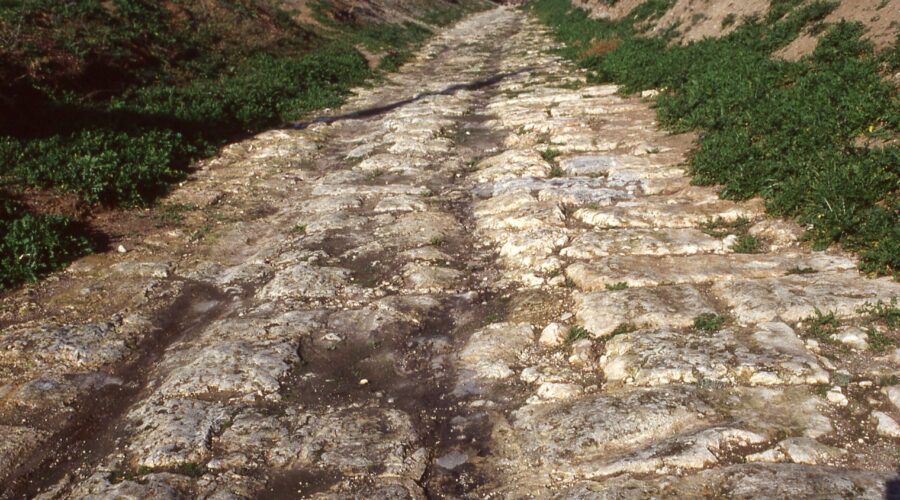
The Diolkos was a specially constructed paved road that allowed the transport of ships from one sea to the other on wooden carriers (olkous). Its construction dates back to around the 6th century BC and is attributed to the wise tyrant of Corinth, Periander. The need for its creation arose from the immense economic and military importance of controlling maritime routes. With the Diolkos, ships avoided the storms of the south, while Corinth accumulated wealth from transit fees, becoming one of the most prosperous city-states.
The road was between 3.4 and 6 meters wide and was paved with limestone slabs. Its most impressive feature was the two parallel grooves in the roadway, which acted as “rails” to keep the wheels of the carriers on track. The process was laborious: ships arrived at the port, were emptied of their cargo to lighten the load, and were then dragged along the land with the help of ropes, winches, and the strength of hundreds of men or animals.
Today, the best-preserved sections of the Diolkos are located near the western end of the modern Canal, in the Posidonia area. Visitors can clearly see the ancient tracks, although the monument remains extremely vulnerable to weather conditions and sea erosion. In recent years, significant restoration and enhancement efforts have been made to protect this unique example of ancient engineering for future generations.
Nero’s Ambitious Attempt in 67 AD
Although many rulers, such as Demetrius Poliorcetes and Julius Caesar, considered the possibility of opening a canal, the only one who dared to begin actual work in antiquity was the Roman Emperor Nero. In 67 AD, during his tour of Greece, Nero arrived at the Isthmus with great solemnity. According to historians of the time, he himself struck the first blow to the ground using a golden pickaxe, signaling the start of one of the largest construction sites of the ancient world.
Thousands of workers were conscripted for the project, including 6,000 prisoners, who began digging simultaneously from both sides of the Isthmus. The Roman engineers’ study was surprisingly accurate, as the alignment they chose almost perfectly matches that of today’s Canal. However, the ambitious plan was abruptly interrupted a few months later. Nero’s departure for Rome due to political unrest and his death in 68 AD put a definitive end to the work, leaving behind unfinished trenches and massive amounts of earth.
Traces of this Roman effort were noticed by 19th-century engineers when the modern excavation began. At certain points on the slopes of the Canal, one can still discern the ancient cuts in the rocks. Furthermore, there is a small monument in the area, a relief plaque on the rock commemorating this historic effort, offering a rare link between Roman megalomania and modern technology.
The Strategic Importance of Corinth and Control of the Seas
The existence of the Diolkos and the excavation attempts were not just technical bets, but the foundation of Corinthian power. Corinth, built on this narrow strip of land, functioned as the “guardian” of the Peloponnese and the regulator of trade between East and West. Its two ports, Lechaion on the Corinthian Gulf and Kenchreai on the Saronic, were bustling with life, hosting goods from every corner of the Mediterranean. Controlling the passage meant controlling wealth, and the Diolkos was the “key” that unlocked this dominance.
Additionally, the Diolkos played a decisive role in military operations. Many times in history, naval fleets were rapidly transported from one sea to the other, allowing generals to surprise their opponents. This dual quality of the Isthmus, as a bridge for the land and a passage for the sea, determined the fate of the region for centuries, making it one of the most coveted places on Greek soil.
Practical Information for Your Visit
Touring the remains of the Diolkos and the site of Nero’s attempt is an extraordinary experience that combines history with the natural beauty of the landscape. Most visible sections of the Diolkos are located on the western side of the Canal, near the Posidonia submersible bridge. Access is relatively easy by car, following the signs for “Posidonia” or “Diolkos.” The site is open and accessible; however, caution and respect for the monument are required, as it is not a fully organized archaeological site with an entrance fee.
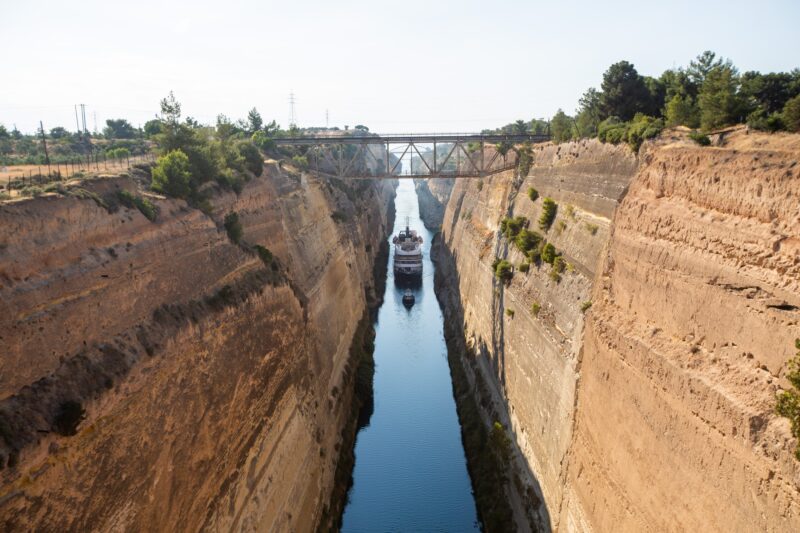
Because the Diolkos is exposed to the elements, the best time to visit is spring or autumn, when the temperature is pleasant for walking by the water. Combine your visit with a stop at the modern Isthmus bridge to see the awe-inspiring Canal from above and, if you’re lucky, watch the passage of a large ship.
- Location: The Diolkos and Nero’s monument are located at the western end of the Canal, in the Posidonia area.
- Protection: Please follow the signs and do not walk on the ancient road. The Diolkos is extremely fragile.
- Combined Routes: You can enrich your excursion by visiting Isthmia and the sanctuary of Poseidon, or by following the suggested route “The Isthmus: Diolkos and Poseidon”.
The Isthmus area is easily accessible from Athens (about an hour’s drive) via the National Road, as well as by the Suburban Railway, making it an ideal destination for a day trip full of historical discoveries.
Photos: Mark Landon (CC BY 4.0, Wikimedia Commons)
Related articles
Not sure where to go next?Every village, sight and beach in Corinthia on one map — save the ones you like and open the route.
Open the mapRecommended in Corinthia
 To polychoro taverna
Eat & Drink · Trikala
 Kryoneri Cultural Association
Festivals & Events · Kryoneri
 Taverna “O Magkas” — Kefalari, Corinthia
Eat & Drink · Kefalari
 Althea Resorts & Spa
Hospitality · Xylokastro
 Kyknos Grill House — Souvlaki & Gyros, Xylokastro
Eat & Drink · Xylokastro
 Sofiadis Plumbing Installations
Services · Kiato
 Froutoplanites — Indoor Playground & Café, Kiato
Eat & Drink · Kiato
 Sophia Blanou — Hair & Make-up Salon
Services · Vrachati
 Dimitra Stathi — Philologist
Services · Kiato
 Corner grill & burger
Eat & Drink · Kiato
 Lia’s Travel
Services · Kiato
 Pleiadon Gi Mountain Resort & Spa
Hospitality · Trikala
 Blank Studio Photoshootings
Services · Kiato
 Root nature cosmetics
Shopping · Riza
Businesses that support Visit Corinthia.
Explore more of Corinthia
Plan your trip to Corinthia
Take the trip quizThings to do there — Corinthia
Optional tours, tickets and activities for your days here — you choose what suits you.
Activities, experiences and local guides — book ahead and skip the queues.
See options →A guided day with transport from Athens to Ancient Corinth and Nafplio, with free cancellation. Also: Corinth Canal & wine tasting, Ancient Corinth half-day
See options →Compare prices from all the major rental companies, with free cancellation on most offers. Also: Loutraki, Nafplio, Argos
See options →Activities are provided and sold by our partners. You complete the booking on their own page, at exactly the same price.
Before you arrive
Arrive in Corinthia already online
Maps, ferry times, a table for tonight — all of it needs data. MyEsim is a Greek eSIM app covering Greece and 180+ countries: install the plan before you fly, and it switches on the moment you land. No queue at the airport, no roaming bill. Visit Corinthia readers get 10% off.
- Covers all of Greece
- Ready in minutes
- No physical SIM
Enter the code at checkout on myesim.gr. Works on iPhone XS and newer and on most Android phones from 2019 onwards.