
Lake Stymphalia: A Mythical Natural Paradise in Corinthia
Article
An Introduction to the Mystical Charm of Stymphalia
In the heart of Mountainous Corinthia, cradled between the imposing massifs of Mount Ziria and Mount Oligyrtos, lies a place where natural beauty harmoniously intersects with ancient Greek mythology. Lake Stymphalia is far more than just a wetland; it is a living monument to nature and culture that has remained virtually unchanged through the passage of centuries. Sitting at an altitude of approximately 600 metres, Stymphalia is the most significant mountain lake in the Peloponnese and stands as one of the most atmospheric destinations in the entire Corinthian region.
The landscape here is a chameleon, shifting dramatically with the turning of the seasons. From the lush, vibrant greens of spring to the ethereal, mist-shrouded reed beds of winter, the lake offers a sensory experience that captivates every traveller. For those seeking a destination beyond the typical tourist path, Stymphalia provides a rare combination of ecological significance, historical depth, and architectural excellence, largely thanks to the award-winning Environment Museum that overlooks its shores.
The Sixth Labour: Where Myth Comes to Life
It is impossible to speak of Stymphalia without invoking the legend of Hercules. According to Greek mythology, this was the site of the hero’s sixth labour: the extermination of the Stymphalian Birds. These man-eating creatures, equipped with bronze beaks, claws, and metallic feathers that they could launch like arrows, had sought refuge in the lake’s dense reeds. They terrorized the local population, destroyed crops, and poisoned the land with their waste.
Hercules, realizing he could not traverse the marshy ground to reach them, received help from the goddess Athena. She provided him with bronze krotala (clappers) forged by the god Hephaestus. By clashing them together, Hercules created a deafening noise that startled the birds into the air. As they took flight, he picked them off one by one with his hydra-poisoned arrows. Beyond its narrative thrill, this myth is often interpreted as a metaphor for early human efforts to reclaim marshland and manage the region’s water resources, as the lake has always been known for its fluctuating water levels and complex drainage systems.
The Environment Museum of Stymphalia: An Architectural Jewel
Perched on the northern slope of a hill overlooking the basin, the Environment Museum of Stymphalia is a centerpiece of the region. Part of the Piraeus Bank Group Cultural Foundation (PIOP) museum network, the building is a masterpiece of bioclimatic architecture. Designed to blend seamlessly into the surrounding landscape, it uses wood and stone to mirror the natural environment it celebrates.
What to Expect Inside the Museum
A visit to the museum is essential for anyone wishing to understand the complex ecosystem of the Stymphalian basin. The permanent exhibition focuses on the delicate interdependence between humanity and the environment. Through interactive displays, detailed models, and rich audiovisual material, visitors can explore several thematic areas:
- Geology and Hydrology: Discover the unique limestone geology of the area and the fascinating network of “katavothres” (sinkholes) that naturally drain the lake’s water into underground rivers.
- Flora and Fauna: Learn about the diverse life forms that inhabit the lake, with a specific focus on the 160 species of migratory and indigenous birds that use the site as a sanctuary.
- Traditional Life: Explore the traditional professions that sustained the local community for generations, such as intricate basket weaving using lake reeds and traditional fishing methods.
- History and Archaeology: Follow the timeline of the region from the prehistoric era through the Classical period and into the Middle Ages.
One of the museum’s most breathtaking features is its cantilevered balcony. From here, visitors can use provided telescopes for birdwatching, taking in panoramic views of the water and the mountains. Keep an eye out for the “Stymphalian Minnow” (Phoxinellus stymphalicus), a rare, endemic fish species that has evolved a remarkable survival strategy: when the lake water recedes during droughts, it survives by burying itself deep in the moist mud.
Ancient Stymphalos and the Zaraka Monastery
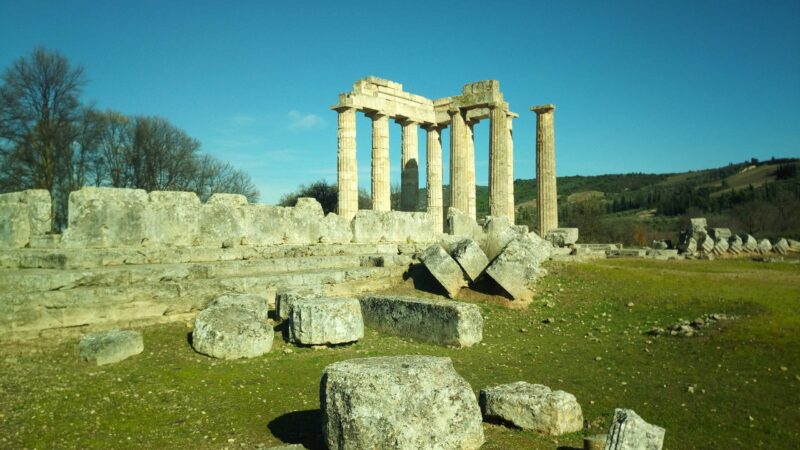
The history of Stymphalia extends far beyond the realm of myth. Just a short distance from the lake’s edge lie the ruins of Ancient Stymphalos. Systematic excavations have uncovered parts of the ancient city’s agora, its formidable walls, and temples that flourished during the Classical and Hellenistic periods. Walking through these ruins, one can visualize the bustling urban centre that once commanded this mountain pass.
Equally fascinating is the Zaraka Monastery, a monument that is entirely unique within the Greek landscape. This 13th-century Cistercian abbey was built by Frankish monks during the period of Latin rule (Latinokratia) following the Fourth Crusade. Its architecture, featuring distinct Gothic elements and pointed arches, is reminiscent of Western European abbeys, creating a striking visual contrast with the traditional Byzantine style usually found in Greece. Interestingly, the monks used architectural members from the nearby ancient ruins to build the monastery, creating a literal layering of history where Hellenistic stones form the foundation of a medieval Catholic abbey.
Ecotourism and Outdoor Activities
Lake Stymphalia is a sanctuary for outdoor enthusiasts and nature lovers. As a protected site within the Natura 2000 network, it serves as a vital refuge for biodiversity, making it a premier destination for ecological tourism.
Hiking and Nature Trails
For those who prefer to explore on foot, several marked trails begin near the museum and lead down toward the lakeshore or up into the surrounding hills. A popular path takes you through the archaeological site of Ancient Stymphalos and toward the water’s edge. Hiking here offers a chance to observe the golden reed beds up close and spot various avian residents, including herons, Eurasian coots, and various birds of prey circling the mountain peaks.
Nature Photography
For photographers, Stymphalia is an inexhaustible canvas. The play of light on the water at sunrise, the reflection of the snow-capped Ziria peaks in the lake’s surface, and the eerie, quiet beauty of the marsh at dusk create scenes that look like oil paintings. The area is particularly beautiful in late autumn when the reeds turn a deep amber and the surrounding plane trees shed their golden leaves.
Gastronomy and Local Flavours
No trip to the Corinthian highlands is complete without indulging in the local culinary traditions. In the villages surrounding the lake, such as Stymphalia and Karteri, traditional tavernas serve authentic mountain fare. The food here is honest, hearty, and rooted in the land.
- Roast Piglet and Lamb: The signature dishes of Mountainous Corinthia, usually slow-roasted on a spit until the skin is perfectly crisp.
- Handmade Pies: Known as “pites,” these are made with hand-rolled phyllo dough and filled with local wild greens or feta cheese produced by nearby shepherds.
- Nemean Wine: Being so close to the famous Nemea wine region, you will find excellent Agiorgitiko reds and local mountain varieties that pair perfectly with roasted meats.
- Legumes and Walnuts: The fertile soil of the basin produces high-quality beans and walnuts, which are staples of the local diet.
Birdwatching Tips
The best viewpoints are at the northern end of the lake, where a small paved road runs along the shore. Set up between dawn and 9am for the best activity. Common sightings include grey heron, great white egret, little bittern and marsh harrier. In winter, large flocks of ducks and coots make the lake feel genuinely wild. A basic spotting scope adds considerably to the experience.
Practical Information for the Visitor
Accessing Lake Stymphalia is both easy and scenic. If you are travelling from Athens or Patras, take the Corinth-Patras national road and exit at Kiato. From there, follow the signs toward Stymphalia. The drive from Kiato takes approximately 40 to 50 minutes, winding through beautiful mountain passes and charming traditional villages.
When to Visit
Stymphalia is a year-round destination, with each season offering a different perspective:
- Spring: Nature is in full bloom, the water levels are high, and the lake is teeming with life. This is the absolute best time for birdwatching.
- Autumn: The forest colours turn to gold and red, and the lake takes on a more melancholic, peaceful atmosphere—perfect for long walks and photography.
- Winter: Snow often dusts the surrounding peaks, and the mist over the lake creates a cinematic setting. It is the ideal time to enjoy the warmth of a fireplace in a stone-built guesthouse.
Local Tip
Consider combining your visit to Stymphalia with a trip to Lake Doxa in the Feneos valley, located about 35-40 minutes further west. While Stymphalia is a shallow, natural wetland steeped in myth, Lake Doxa is a deep, alpine-style reservoir. Together, they form the “twin lakes” of Corinthia and offer a complete picture of the region’s diverse natural beauty.
Conclusion
Lake Stymphalia is not merely a stop on a map; it is a profound connection to the past. It is a place where the echoes of Hercules’ labors still seem to whisper through the reeds and where the architecture of the Middle Ages meets the ruins of Antiquity. Whether you are a history buff, a nature enthusiast, or simply a traveller looking for the profound silence of the mountains, Stymphalia will reward you with memories that linger long after you leave. On your next journey through Corinthia, let the mythical aura of this ancient lake lead the way.
Planning your visit to Corinthia?
Visit Corinthia is the travel guide for the region — hotels, tavernas, wineries and things to do, all in one place.
Related articles
Not sure where to go next?Every village, sight and beach in Corinthia on one map — save the ones you like and open the route.
Open the mapRecommended in Corinthia
 To polychoro taverna
Eat & Drink · Trikala
To polychoro taverna
Eat & Drink · Trikala
 Corner grill & burger
Eat & Drink · Kiato
Corner grill & burger
Eat & Drink · Kiato
 Root nature cosmetics
Shopping · Riza
Root nature cosmetics
Shopping · Riza
 Kryoneri Cultural Association
Events · Kryoneri
Kryoneri Cultural Association
Events · Kryoneri
 Dimitra Stathi — Philologist
Services · Kiato
Dimitra Stathi — Philologist
Services · Kiato
 Lia’s Travel
Services · Kiato
Lia’s Travel
Services · Kiato
 Pleiadon Gi Mountain Resort & Spa
Hospitality · Trikala
Pleiadon Gi Mountain Resort & Spa
Hospitality · Trikala
 Blank Studio Photoshootings
Services · Kiato
Blank Studio Photoshootings
Services · Kiato
Businesses that support Visit Corinthia.
Explore more of Corinthia
Plan your trip to Corinthia
Take the trip quizThings to do there — Corinthia
Optional tours, tickets and activities for your days here — you choose what suits you.
Activities, experiences and local guides — book ahead and skip the queues.
See options →A guided day with transport from Athens to Ancient Corinth and Nafplio, with free cancellation. Also: Corinth Canal & wine tasting, Ancient Corinth half-day
See options →Compare prices from all the major rental companies, with free cancellation on most offers. Also: Loutraki, Nafplio, Argos
See options →Activities are provided and sold by our partners. You complete the booking on their own page, at exactly the same price.
Before you arrive
Arrive in Corinthia already online
Maps, ferry times, a table for tonight — all of it needs data. MyEsim is a Greek eSIM app covering Greece and 180+ countries: install the plan before you fly, and it switches on the moment you land. No queue at the airport, no roaming bill. Visit Corinthia readers get 10% off.
- Covers all of Greece
- Ready in minutes
- No physical SIM
Enter the code at checkout on myesim.gr. Works on iPhone XS and newer and on most Android phones from 2019 onwards.