
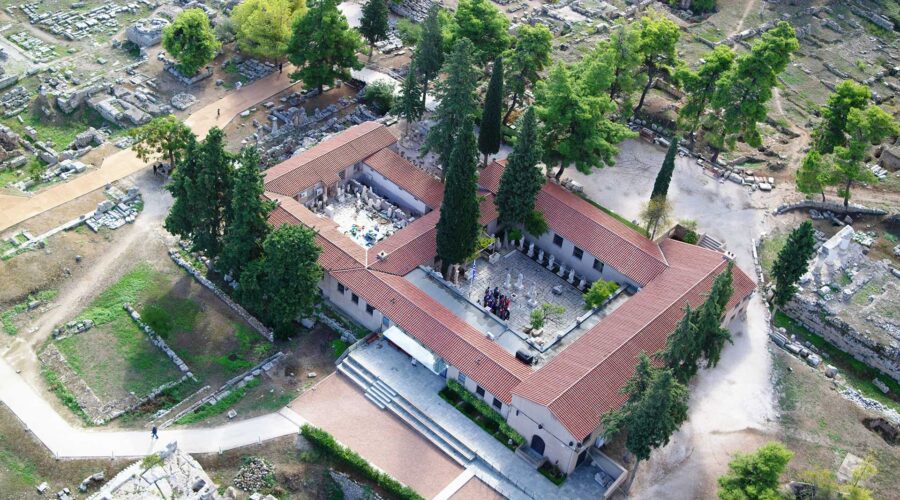
The Archaeological Museum of Ancient Corinth: what to see
ArticleWithin the imposing archaeological site of Ancient Corinth, just a stone’s throw from the iconic Temple of Apollo, the Archaeological Museum stands as a guardian of historical memory. It is not merely an exhibition space, but the point where the grandeur of the ancient city-state comes to life through the rich findings of systematic excavations conducted in the area for decades. It is worth dedicating substantial time to it, as a visit to the museum completes the experience of touring the ruins, giving shape and detail to the daily life and art of the people who lived in this strategic corner of the Peloponnese.
The tour through its halls offers a journey through time, from the dawn of civilization to the Byzantine period. Each exhibit tells a story about Corinth, which was one of the most important commercial and cultural centers of the ancient world, known for its wealth, its innovations in pottery, and its pivotal role between the eastern and western Mediterranean.
The Architecture and History of the Building
The building housing the collections has its own historical value. It was built in 1931–1932 based on designs by architect Stuart Thomson, who was a member of the American School of Classical Studies. Its construction was made possible thanks to a generous donation by Ada Small Moore, with the aim of safely housing the numerous excavation finds that had already begun to come to light. The original building was designed with the needs of the time in mind, offering a functional space that harmonizes with the surrounding landscape of the archaeological site.
As excavation activities continued and the volume of finds grew, its expansion became necessary. Thus, in 1951, the west wing was added, allowing for better organization of the collections and the highlighting of more aspects of Corinthian history. Today, the museum maintains its classical aura, while its interiors have been modernized to offer a more friendly and educational experience to the visitor, always maintaining respect for the historical heritage it hosts.
A Tour of the Museum’s Collections
The museum’s collections are structured in such a way as to cover the entire journey of Corinth through the centuries. Starting from the prehistoric collection, the visitor can see vessels and tools that testify to the habitation of the area from very early on. Particular emphasis is placed on the famous Corinthian pottery. The city was renowned for its workshops and the production of vases with characteristic decoration, which were exported throughout the then-known world, constituting one of the strongest “brand names” of antiquity.
Moving through the halls, you will encounter impressive sculptures, inscriptions that provide information about public life, and portraits dating from the Roman period, when Corinth experienced a new era of great prosperity as a Roman colony. Also very significant is the collection of finds from the Asklepieion of Ancient Corinth. These are votive offerings (tamas) in the shape of human limbs, which patients offered to the god of medicine hoping for their cure, offering us today a unique glimpse into the perceptions of health and religion at that time.
The Treasures of the Roman and Byzantine Periods
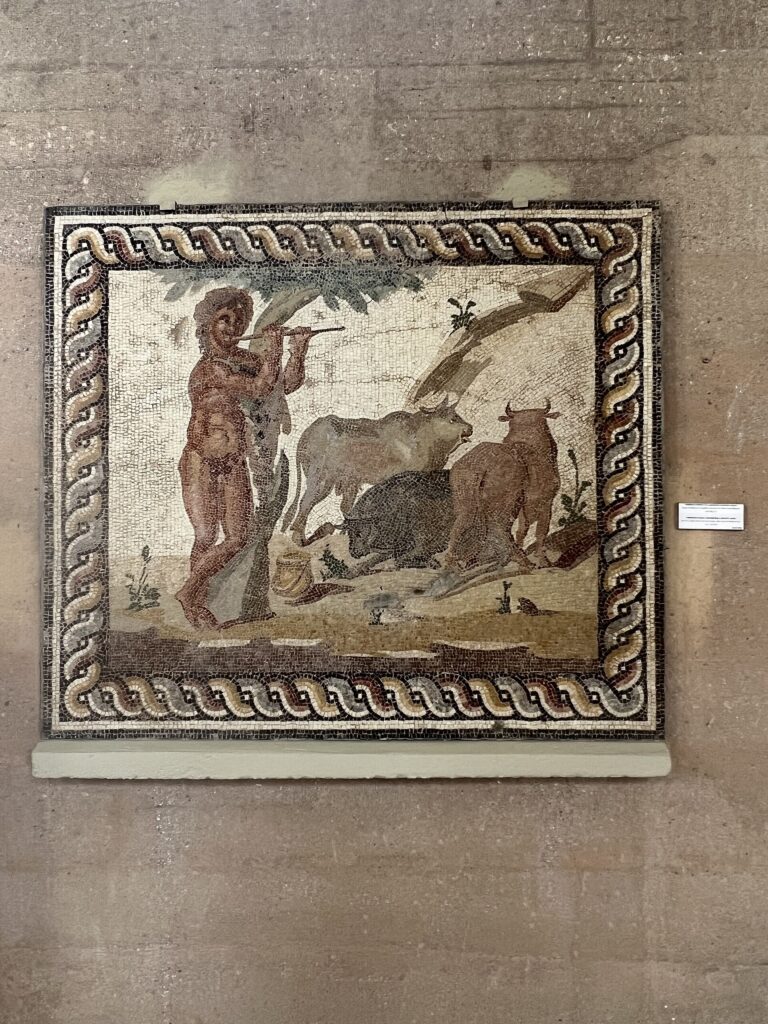
One of the most impressive elements of the museum is the elaborate mosaic floors that have been preserved. These works of art, which once adorned wealthy Roman villas, impress with their detail and the vibrancy of their colors, depicting geometric shapes or scenes from mythology. Their presence testifies to the luxury and high standard of living enjoyed by the inhabitants of Corinth during Roman times, when the city was the capital of the province of Achaia.
The journey concludes with the Byzantine collection, which includes objects of daily use, jewelry, and ecclesiastical items. These finds illuminate the continuity of life in Corinth after antiquity, showing how the city adapted to the new religious and social conditions of Byzantium. It is a reminder that Corinth never ceased to be a living organism, constantly evolving through the challenges of the centuries.
Practical Information and the Best Time to Visit
To properly organize your visit, you should know that there is a unified ticket which covers both entrance to the archaeological site and the museum. This allows you to wander freely between the monuments and the exhibitions. Opening hours change depending on the season (summer and winter), so it is always wise to check before your departure. The museum is an excellent stop, especially during the hot noon hours of summer, as its air-conditioned halls offer coolness and respite at a time when the outdoor archaeological site provides very little shade.
The best time to visit Ancient Corinth is spring and autumn. At these times, temperatures are mild and the landscape around the ruins is lush green or dressed in autumn colors, making the tour much more pleasant. If you choose summer, make sure to be there early in the morning. Don’t forget to wear comfortable shoes, as the ground in the archaeological site is uneven, and have water with you, although you can purchase necessities from the shops in the adjacent village of Ancient Corinth.
How to Get There and What Else to See in the Area
Access to the Archaeological Museum and the archaeological site is very easy. From Athens, the distance is about an hour by car via the National Road. Alternatively, you can use the Suburban Railway (Proastiakos) to Corinth station and from there take a taxi or local bus to Ancient Corinth. The route is pleasant and gives you the opportunity to see the modern city of Corinth with its beautiful beach.
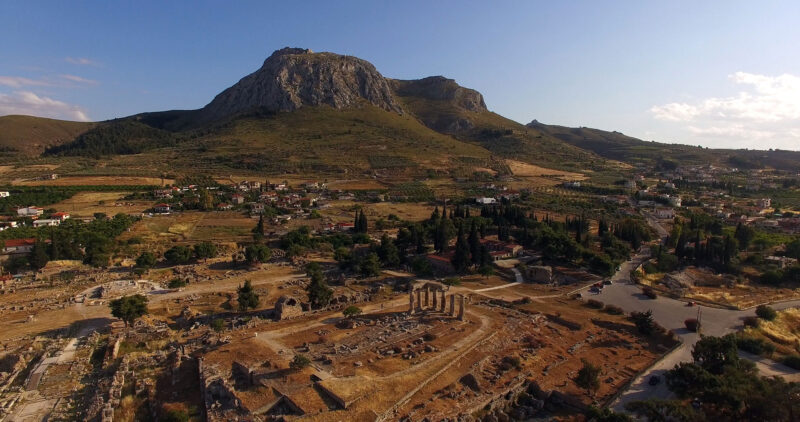
Combine your visit to the museum with an ascent to the imposing Acrocorinth, the castle that dominates the ancient city and offers one of the most breathtaking views in Greece. Also, a short distance away is Lechaion, the ancient port of Corinth on the Corinthian Gulf, where you can see the remains of the harbor facilities that made the city a maritime power. The area around the museum is full of traditional taverns and cafes where you can rest after your tour, enjoying the local hospitality.
Photos: Van Der Meulen Christofle (CC0, Wikimedia Commons)
Related articles
Not sure where to go next?Every village, sight and beach in Corinthia on one map — save the ones you like and open the route.
Open the mapRecommended in Corinthia
 Froutoplanites — Indoor Playground & Café, Kiato
Eat & Drink · Kiato
 Sophia Blanou — Hair & Make-up Salon
Services · Vrachati
 Dimitra Stathi — Philologist
Services · Kiato
 Corner grill & burger
Eat & Drink · Kiato
 Lia’s Travel
Services · Kiato
 Blank Studio Photoshootings
Services · Kiato
 Root nature cosmetics
Shopping · Riza
 To polychoro taverna
Eat & Drink · Trikala
 Kryoneri Cultural Association
Festivals & Events · Kryoneri
 Taverna “O Magkas” — Kefalari, Corinthia
Eat & Drink · Kefalari
 Althea Resorts & Spa
Hospitality · Xylokastro
 Kyknos Grill House — Souvlaki & Gyros, Xylokastro
Eat & Drink · Xylokastro
 Sofiadis Plumbing Installations
Services · Kiato
Businesses that support Visit Corinthia.
Explore more of Corinthia

Plan your trip to Corinthia
Take the trip quizBefore you arrive
Arrive in Corinthia already online
Maps, ferry times, a table for tonight — all of it needs data. MyEsim is a Greek eSIM app covering Greece and 180+ countries: install the plan before you fly, and it switches on the moment you land. No queue at the airport, no roaming bill. Visit Corinthia readers get 10% off.
- Covers all of Greece
- Ready in minutes
- No physical SIM
Enter the code at checkout on myesim.gr. Works on iPhone XS and newer and on most Android phones from 2019 onwards.