 visitcorinthia.com
Ancient Corinth: The Complete Guide to the Archaeological Site
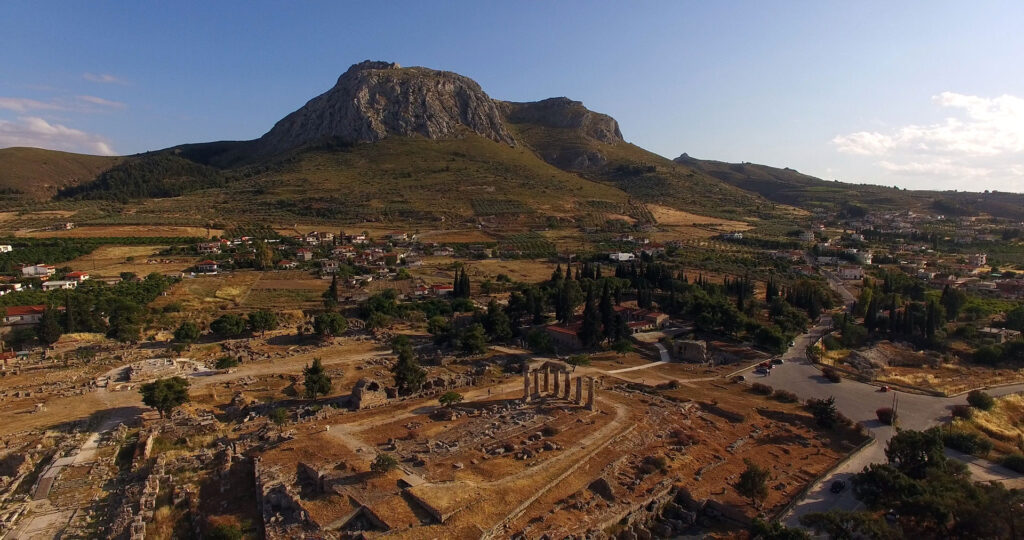
Few places in Greece carry so many layers of history as Ancient Corinth. Here stood one of the wealthiest cities of antiquity — a commercial hub controlling two seas and two harbours. Today, just 5 km from modern Corinth, the archaeological site waits with open arms.
What to See
The Temple of Apollo
Seven of the original 38 monolithic Doric columns still stand — each hewn from a single piece of limestone and dated to around 560 BC, making them among the earliest standing columns in Greece. The sheer scale of them in person is more impressive than any photograph: 6.3 metres tall, 1.8 metres in diameter at the base, and the texture of the stone still rough and readable from the ancient quarry. Walk around the base, get close to the material, and you understand what architects were trying to do before Classical refinement arrived.
The Roman Forum
Rome destroyed Corinth in 146 BC and rebuilt it a century later as a Roman colony. The forum they built is vast — one of the largest in the Roman world outside Rome itself — and the ruins that remain convey the scale of what the city became. The bema (speaker’s platform), where Paul of Tarsus stood to defend himself before the Roman governor Gallio around 50 AD, is clearly identified. Standing there, you’re on ground where a moment in the history of early Christianity actually happened.
The Archaeological Museum
One of the best regional museums in Greece. The collection includes significant mosaics from Roman Corinth, sculptural finds from the Greek sanctuary, a room of erotic terra-cottas from the Aphrodite cult, and pottery spanning several centuries. Allow at least 45 minutes; the museum consistently rewards that time. Closed Tuesdays.
Practical Info
The site and museum are at the edge of Archaia Korinthos village, 7 km southwest of modern Corinth city. Opening hours are roughly 8am–7pm in summer, 8am–3pm in winter (check current hours with the Ministry of Culture website, as they adjust seasonally). The combined site-and-museum ticket is approximately €12. Free parking in the village square. No food facilities on-site; a few tavernas and cafés in the village itself.
Dress appropriately for uneven terrain — the site is large and the ground is stony in places. Water is essential from May through September. Morning visits are cooler and the light is better for photographs of the temple. Plan to spend two hours minimum; three if you include the museum carefully.
Acrocorinth
Ancient Corinth is incomplete without Acrocorinth — the 575-metre hilltop fortress that rises directly behind the lower city. The visible walls are a palimpsest: Greek, Byzantine, Frankish, Venetian and Ottoman layers, each built on or into what came before. Inside the outer wall, the ruins of mosques, churches, water cisterns and towers span twelve centuries of occupation without pause. The summit offers the widest view of any point in the northern Peloponnese.
Acrocorinth is free to enter, open daily, and can be combined with Ancient Corinth in a single visit. Drive up the access road (6 km of switchbacks) rather than walking in summer. The outer gate is the most dramatic approach; enter through it and follow the path to the inner keep. Allow a minimum of 90 minutes for the full circuit.
Related articles
Scan to open the page with maps, photos and updates.
Printed on: 18/10/2026