 visitcorinthia.com
Acrocorinth: The Imposing Castle Overlooking Two Seas
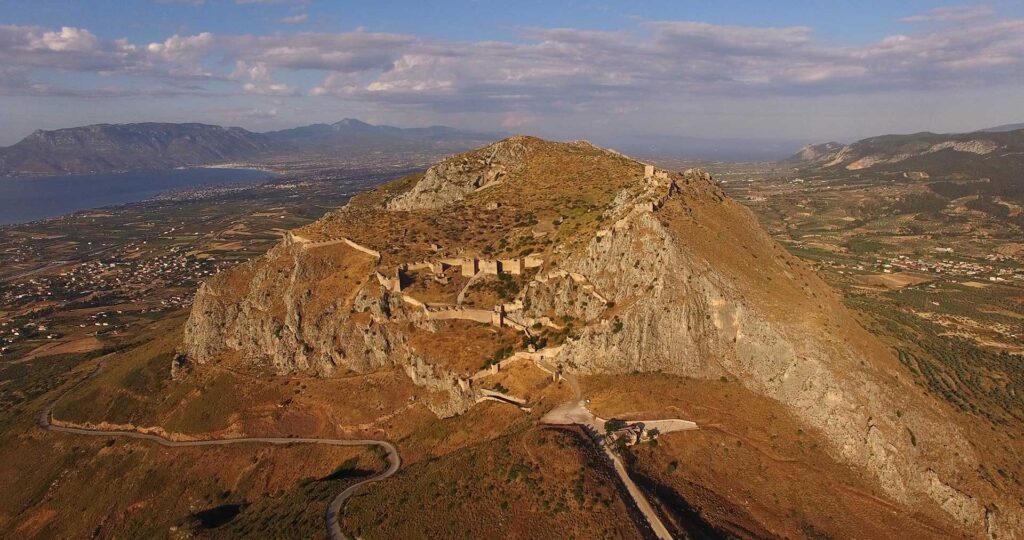
Standing atop a massive limestone monolith that rises 575 metres above the fertile plains of Ancient Corinth, Acrocorinth is more than just a fortification; it is a timeless witness to the unfolding of Greek history. Frequently described as the oldest, largest, and most imposing castle in the Peloponnese, its sheer scale and strategic position are breathtaking. For millennia, this “Gibraltar of Greece” controlled the Isthmus, the narrow strip of land connecting the Peloponnese to mainland Greece, making it a “bone of contention” for every empire that sought to dominate the Mediterranean.
When you visit Acrocorinth, you aren’t just looking at ruins. You are walking through layers of human civilization where ancient Greek mythology meets Byzantine grandeur, Frankish fortification techniques, Venetian elegance, and Ottoman influence. It is a place where the legend of the winged horse Pegasus still resonates near hidden springs, and the spiritual aura of Aphrodite lingers on the mountain’s highest peak. For the modern traveller, it offers one of the most rewarding hikes and historical explorations in the entire Corinthia region.
The Historical Journey of Acrocorinth
The history of Acrocorinth begins in the mists of antiquity. In ancient times, the acropolis of Corinth was sacred to the goddess Aphrodite. Legend tells of a small but fabulously wealthy temple at the summit, where devotees would climb to honour the goddess of love. During the Classical period, the castle’s fortifications were linked to the “Long Walls” that stretched all the way down to the port of Lechaion, making Corinth one of the most impregnable city-states of the ancient world.
With the rise of the Byzantine Empire, the fortress was significantly reinforced to serve as the primary defensive hub of the Peloponnese against barbarian incursions. Its importance only grew during the Middle Ages. Following the Fourth Crusade, the Franks took control, followed by the Venetians, both of whom added their own architectural signatures to the walls. During the Ottoman era, Acrocorinth was one of the key fortresses of the Peloponnese, and Corinth was initially the seat of the Ottoman sanjak of the Morea. The castle’s liberation in 1822 was a pivotal moment in the Greek War of Independence, symbolizing the Greek people’s reclaiming of their ancestral land. Today, every stone in the castle walls tells a story of siege, surrender, and triumph.
The Three Sequential Gates: An Architectural Experience
One of the most striking features of Acrocorinth is its defensive architecture, most notably the system of three successive gates that visitors must pass through to enter the interior. This “onion-style” defence meant that even if an enemy breached one gate, they would find themselves trapped in a killing zone before the next.
- The First Gate: This is the outermost entrance, featuring a massive moat and a drawbridge (now a permanent ramp). It displays heavy Ottoman and Venetian influences, and it is here that the visitor first feels the daunting scale of the fortifications.
- The Second Gate: An impressive two-story structure with distinct Byzantine elements. It was flanked by powerful towers and served as a secondary stronghold, narrowing the path for any potential invaders.
- The Third Gate: The innermost gate, which sits upon foundations dating back to the Classical era. As you pass through this final portal, you officially enter the heart of the “Kastro-politeia” (castle-city).
What to See Inside the Castle Walls
Exploring Acrocorinth requires time, sturdy shoes, and a spirit of adventure. The interior is a vast archaeological park where ruins from different eras coexist in a wild, evocative landscape. Because the site is so large, it is easy to find a quiet corner to contemplate the history surrounding you.
The Upper Peirene Spring
This is perhaps the most famous spring of antiquity. According to Greek mythology, it was here that the hero Bellerophon managed to tame the winged horse Pegasus while the creature was drinking water. The spring is subterranean, reached by a flight of stone stairs leading into a cool, vaulted chamber. Even in the height of summer, the water remains fresh and cold, a silent reminder of the city’s ancient myths and the geological wonders of the limestone rock.
The Temple of Aphrodite
At the very highest point of the rock, known as the “Acros,” lie the foundations of the ancient Temple of Aphrodite. While only the base of the structure remains today, the location offers a panoramic view that is truly beyond description. From this vantage point, your eyes can travel from the mountains of Central Greece to the peaks of the Peloponnese, and from the blue expanse of the Saronic Gulf to the deep waters of the Corinthian Gulf. It is said that on a very clear day, you can even spot the Acropolis of Athens in the far distance.
Ottoman Structures and the Frankish Tower
As you wander the paths, you will encounter the remains of several mosques, including the well-preserved minaret bases, as well as Ottoman baths and massive underground cisterns designed to sustain the garrison during long sieges. On the southwest side of the fortress, the imposing Frankish Tower stands tall, providing an excellent perspective of the western fortifications and the rugged terrain beyond.
The View of Two Seas: A Unique Geographic Phenomenon
Acrocorinth is perhaps the only place in Greece where you can so clearly grasp the geographical significance of the Isthmus. To the east, the Saronic Gulf stretches out toward the Aegean; to the west, the Corinthian Gulf leads the way toward the Ionian Sea. This dual view is not just aesthetically stunning; it explains why Corinth became the wealthiest city-state of antiquity. By controlling this high ground, the Corinthians controlled the trade routes between the East and the West, charging tolls and providing a safe passage for goods that would otherwise have to sail around the dangerous Cape Maleas.
Practical Tips for Your Visit
A visit to Acrocorinth is a physical experience that requires some preparation. To make the most of your trip, keep the following in mind:
- Footwear: Wear comfortable hiking boots or high-quality sneakers. The paths are steep, uneven, and the ancient stones have been polished smooth by centuries of footsteps, making them very slippery, especially when descending.
- Hydration and Snacks: There are no shops or cafes once you pass the first gate. Bring plenty of water, especially during the summer. A small snack is also recommended as the climb to the summit is a workout.
- Sun Protection: Shade is almost non-existent on the rock. A hat, high-SPF sunscreen, and sunglasses are absolute necessities. The sun reflects off the limestone, increasing its intensity.
- Best Time to Visit: The ideal time is early in the morning (as soon as the site opens) or late in the afternoon. This allows you to avoid the midday heat and catch the “golden hour,” when the sun paints the stone walls in hues of orange and gold. Spring is particularly beautiful, as the ruins are covered in carpets of wildflowers.
How to Get There
Acrocorinth is located just a few minutes’ drive from the village of Ancient Corinth. From the modern city of Corinth, the drive takes about 10-15 minutes. The road is paved and winds steeply up the mountain but is well-signposted. There is a parking area near the first gate where the pedestrian path begins.
If you are vacationing in Corinthia, Acrocorinth is a “must-see” destination. We highly recommend combining your visit with a stop at the Archaeological Site of Ancient Corinth and its Museum at the base of the hill. This provides a complete picture of the region’s historical importance and the relationship between the lower city and its protective citadel.
Why Visit Acrocorinth Today?
In a world that is constantly changing, Acrocorinth remains a rock of stability and enduring beauty. It is a place that makes you feel small in the face of history’s vastness, yet simultaneously grants a sense of immense freedom as you gaze out over the horizon. Whether you are a history buff, a photography enthusiast, or someone simply seeking the peace of nature with the best view in Corinthia, Acrocorinth will reward you.
Don’t forget to bring your camera. The angles of the crumbling walls, the gates that frame the deep blue of the sea, and the sheer verticality of the cliffs create the perfect backdrop for unforgettable photos. Acrocorinth isn’t just a tourist attraction; it is a life experience in the heart of Corinthia that connects you to the very roots of Western civilization.
===DONE===
Planning your visit to Corinthia?
Visit Corinthia is the travel guide for the region — hotels, tavernas, wineries and things to do, all in one place.
Related articles
Scan to open the page with maps, photos and updates.
Printed on: 11/10/2026